
Queensland Hospital Watch: a website families can use from a hospital bedside
Queensland Hospital Watch is a volunteer-led not-for-profit that helps patients, families, carers and healthcare workers find their way through Queensland's hospital system.
We designed and built its new WordPress website, then donated it: plain-language guides, a find-your-next-step tool and volunteer pathways that the QHW team can run and grow itself.
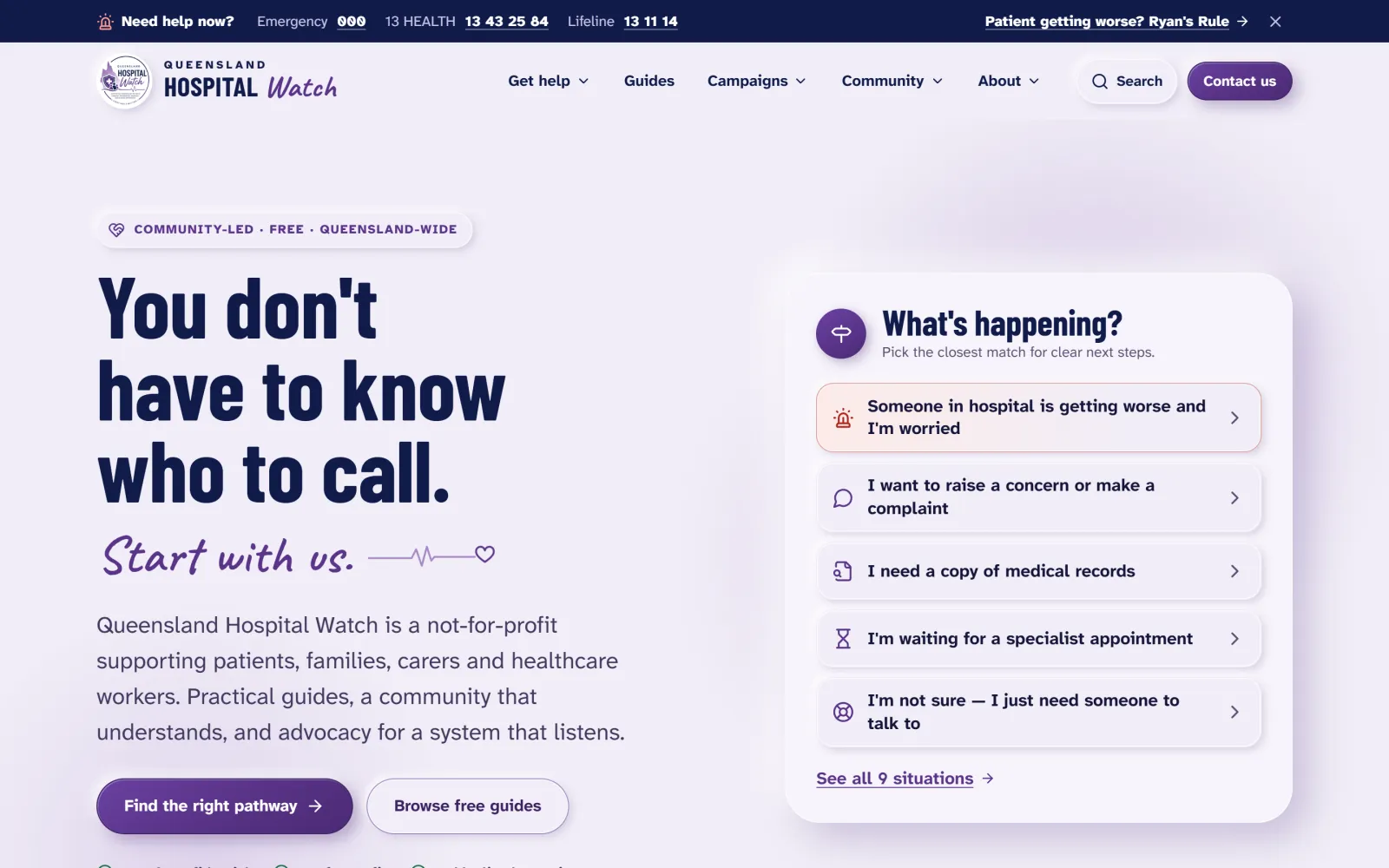
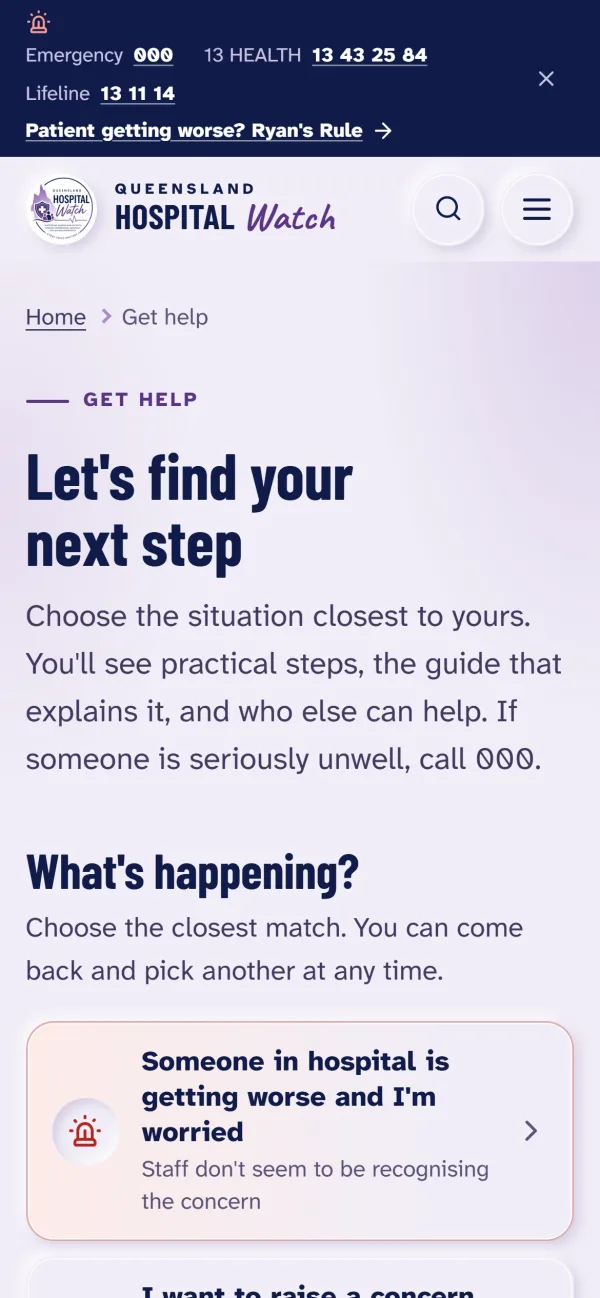
- Situations in the next-step tool 9 Each with steps, a guide and who can help
- Free patient guides 8 To read, print, download or share
- Community support pilots 2 Townsville and Ipswich, with room for more
- QHW community partner First Christine White Community Partnership Program
- Client
- Queensland Hospital Watch Limited
- Sector
- Queensland not-for-profit: patient support, healthcare navigation and advocacy
- Platform
- WordPress, built to be run in-house by the QHW team
- Our role
- Structure, design, build, content migration, forms, training and handover
- Delivered
- September to October 2026, live on QHW's own hosting
- Basis
- Donated by Lovely Pixel
A not-for-profit that grew from one family's story
Queensland Hospital Watch was founded by Rosemary Wanless and Brooke Watson after the death of their mum, Christine White, in August 2025. What began as two daughters trying to understand what had happened became a commitment to help other people feel less alone in the healthcare system.
Today QHW supports patients, families, carers and healthcare workers through advocacy, healthcare navigation, information, community connection and practical non-clinical support, including volunteer networks for adults in hospital who have little or no support nearby.
“We couldn't change what happened to Mum, but we could make sure her story mattered.”
A website the team could grow without calling a developer
QHW asked for a written quote to include in a community grant application, one that favoured Ipswich-based suppliers. Their work was changing quickly, and the most important requirement was independence: they did not want to lodge a support request, or pay a fee, every time they added a pilot or a resource.
- Add pilot locations, pages, resources and forms in-house
- A clear support pathway for patients, families and carers
- An expandable resources hub of guides and services
- Volunteer information and application pathways
- Mobile-friendly, accessible and easy to navigate
- Keep their own domain, email and full ownership
- Avoid unnecessary ongoing costs and subscriptions
- Training and a handover so the team felt confident
We built the website before we sent the quote
Replying with a price and a list of promises would not have shown QHW much. So we built a working WordPress site from their own material, including their pages, their patient guides, the Townsville pilot and their parking campaign, and sent it as the proposal. It sat behind a password so search engines could not find it, and Rosemary and Brooke could click through it themselves on a phone and a computer.
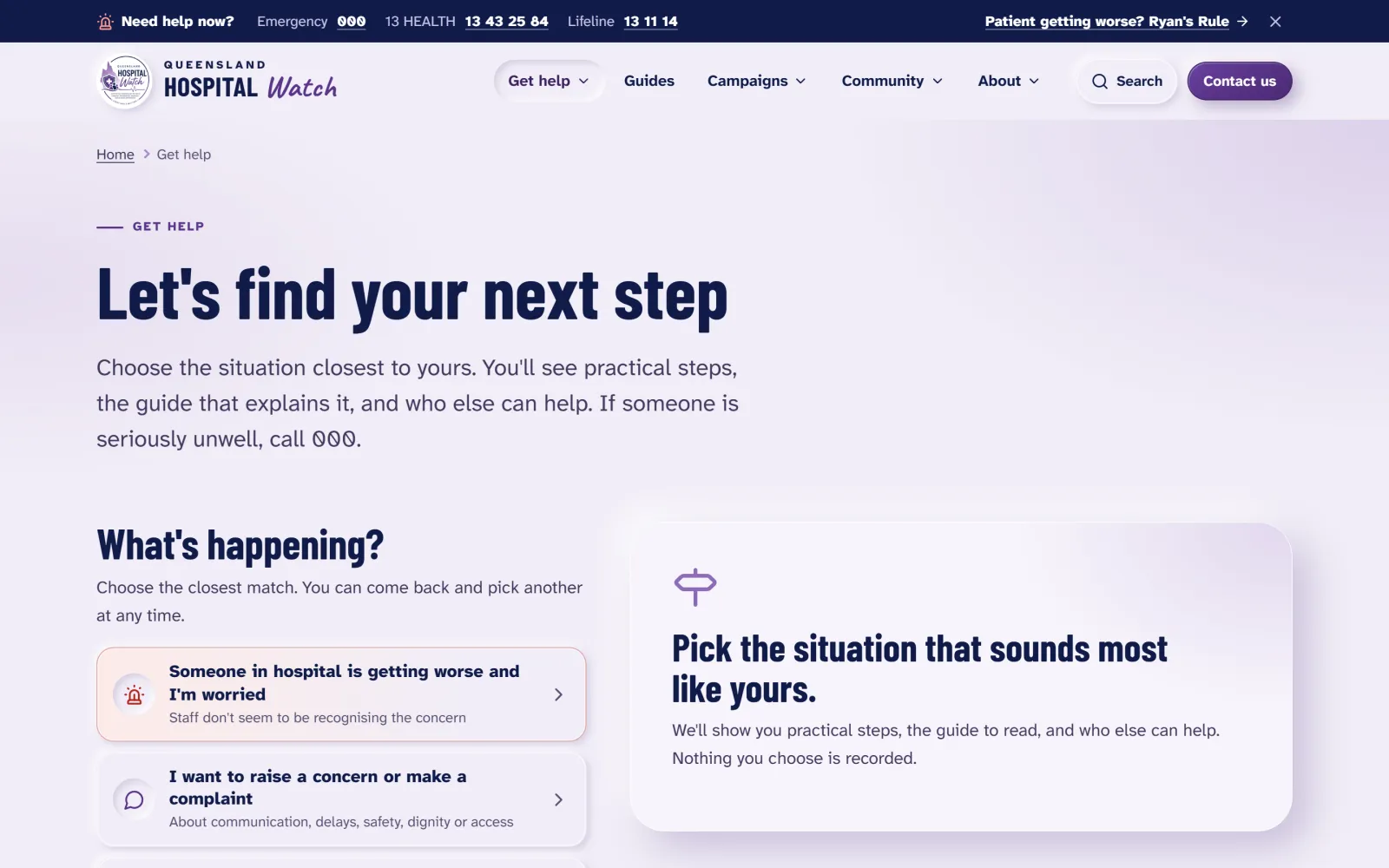
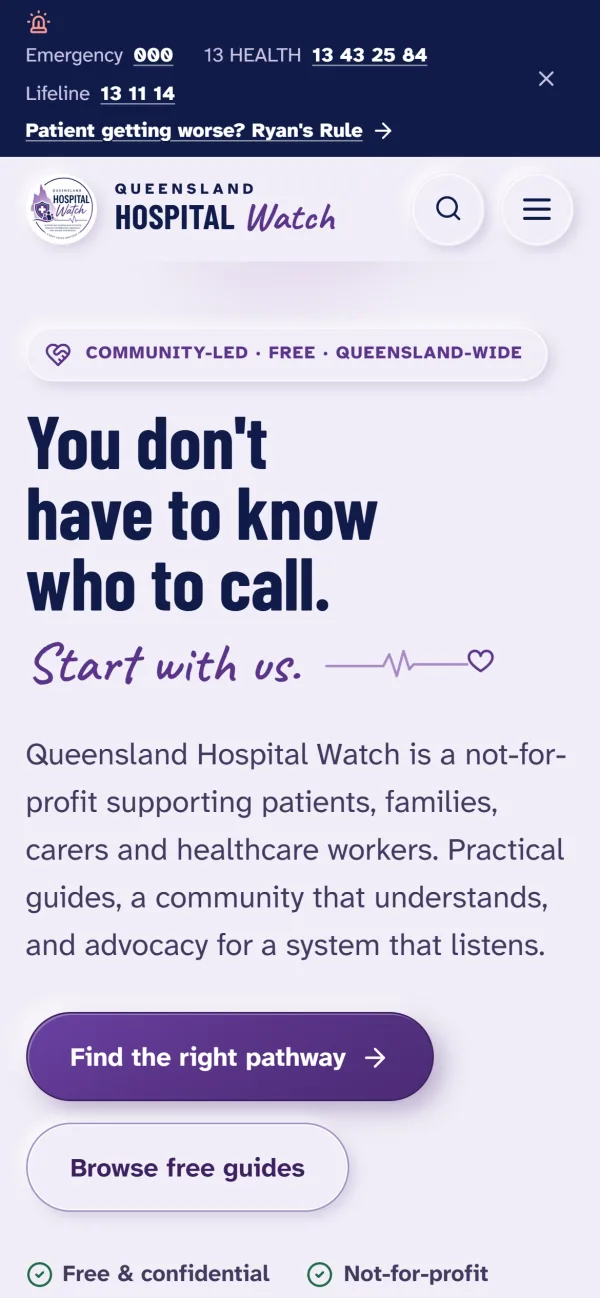
The design started from one person: someone holding a phone in a hospital corridor or beside a bed, worried and short on time. That shaped everything else. Emergency numbers sit at the top of every page. The homepage asks a single question, “What's happening?”, and each answer leads to practical steps, the guide that explains them and who else can help. Nothing a visitor chooses is recorded.
Practical help first, and a site the team can run
Every feature had to work for a worried visitor on a phone and for two founders updating the site between everything else they do.
A find-your-next-step tool
Nine common situations, from a patient getting worse to a complaint that was not resolved. Each one shows practical steps, the guide that explains them and who else can help, with Ryan's Rule one tap away from every page.
Free guides people can share
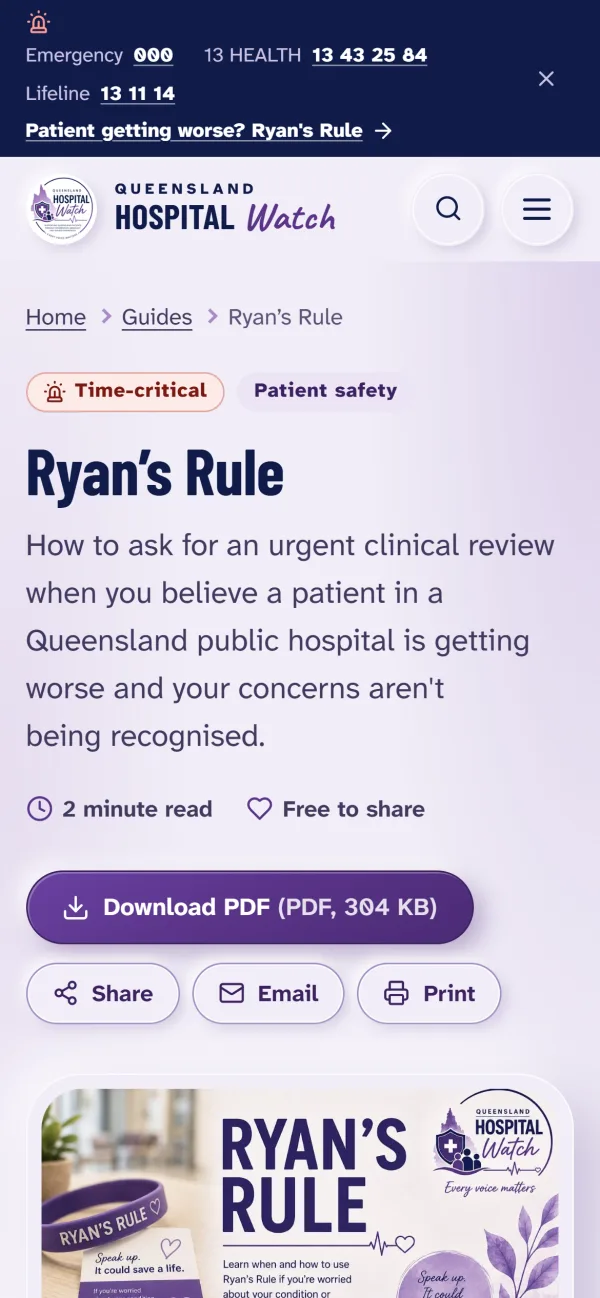
Eight plain-language guides, on topics such as Ryan's Rule, medical records and specialist waitlists. Each one can be read on screen, downloaded as a PDF, printed or emailed to the person who needs it.
Pilots the team adds itself
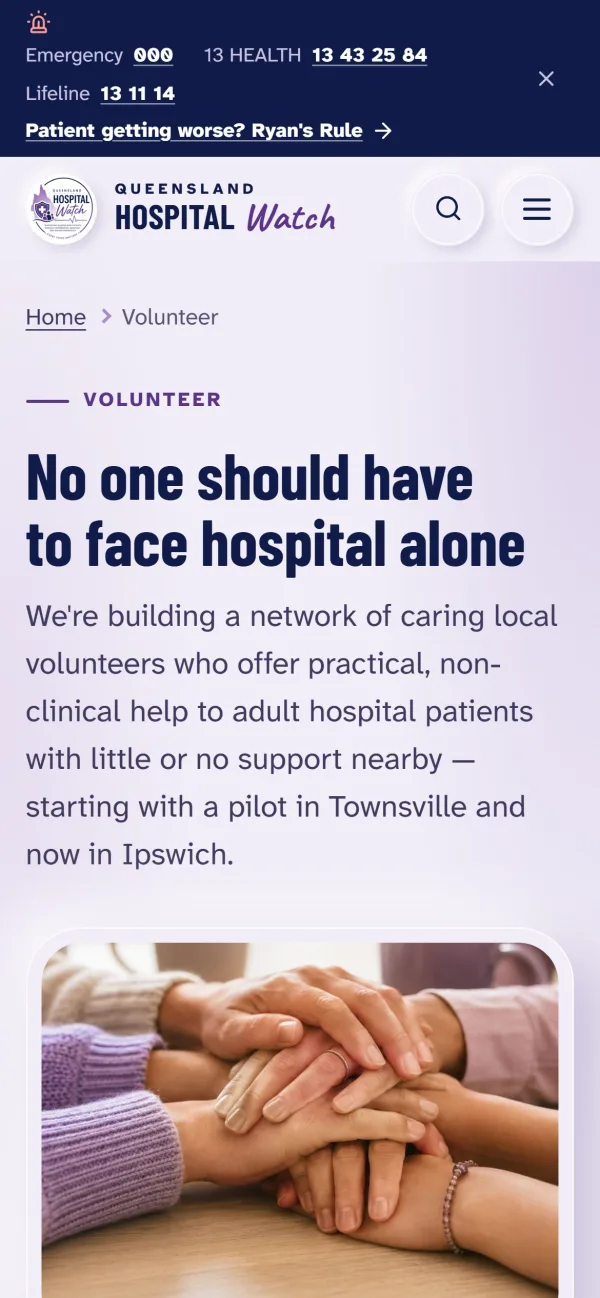
QHW's Community Support Network pilots each have their own page, starting with Townsville and now Ipswich. A new pilot location is a new page from a ready-made layout, with no developer involved.
Volunteer applications without Jotform
The application now lives inside the website. It asks for an emergency contact and two referees, records each consent as a clear yes or no, and stops anyone under 18 from applying. Applications sit in the dashboard and export to a spreadsheet.
Donations without overpromising
Whether a donation is tax-deductible depends on DGR status, so nothing on the site says or implies it until that is confirmed. Until a provider is chosen, the Donate buttons open an email to the team. Switching providers later is one field.
Run it without a developer
Rosemary and Brooke each have their own administrator account, a written handbook with screenshots and an in-person walkthrough. They can also connect ChatGPT or Claude and ask for changes in plain words; every change is listed and can be undone with one click.
What QHW kept
- Their domain
- Their email
- Full ownership of the site and accounts
- Every old link, redirected to the right new page
Designed for the place people actually read it
Real screens from the live site. Most visitors arrive on a phone, so every page was designed for one first.
The grant fell through, so we gave them the website
When we sent the proposal, we made QHW a promise: if the grant application was not successful, the website was theirs anyway, set up, with training and a handover, at no cost. In early October QHW let us know the grant had not come through. So we kept the promise.
-
16 September
Request for a quote
A written quote for a community grant application, with a detailed list of what the site needed to do.
-
22 September
A working website as the proposal
A page-by-page tour of the new site, a formal quote for the grant and the offer to donate it if the grant failed. QHW accepted the same morning.
-
28 September
Their own preview to click through
A private preview link, the volunteer form expanded to match their screening process, and the donation wording reviewed.
-
21 October
Walkthrough and launch
An in-person walkthrough of running the site, then the new website went live on QHW's own hosting within hours, with every old link redirected.
Since launch the site has kept growing, with the Ipswich Community Support Network pilot now on its own page alongside Townsville.
The first partner in the Christine White Community Partnership Program
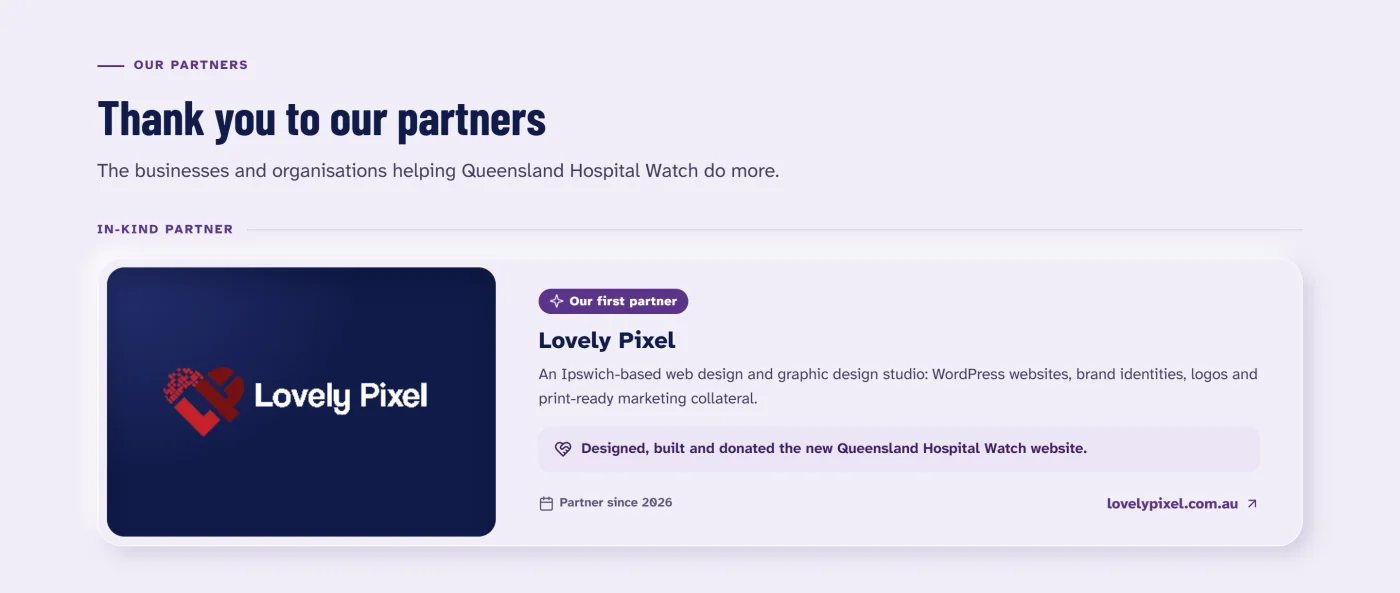
In return for the donated website, Queensland Hospital Watch made Lovely Pixel the first partner in its Christine White Community Partnership Program, which recognises businesses that support QHW's work with money or skills. Lovely Pixel is listed as an in-kind partner, and QHW's website now credits the studio on every page.
“Designed, built and donated the new Queensland Hospital Watch website.”
The program is about recognition, not influence: partners have no say in QHW's advocacy, cases or public positions, and the word "partner" does not mean a business partnership.
Questions this project answered
Often, yes. Queensland Hospital Watch's volunteer application is now part of their WordPress site. It asks for an emergency contact and two referees, records each declaration and consent as a clear yes or no, stops anyone under 18 from applying, and keeps every application in the website's dashboard, where it can be exported as a spreadsheet, so no separate form subscription is needed for it. Sensitive documents are deliberately not uploaded through the site.
It must not say or imply that donations are tax-deductible. Until Queensland Hospital Watch chooses a donation provider, its Donate buttons open an email to the team, with a short note that online donations are not open yet. The page stores the donation link in one field, so switching to GiveNow, Chuffed, Stripe or another provider later means changing one setting rather than rebuilding anything.
They can, when the website is set up for it. The Queensland Hospital Watch site has an AI connections page in its dashboard: the team can connect ChatGPT or Claude and ask for changes in their own words. Every change the assistant makes is listed on that page and can be undone with one click, so the team stays in control.
Start from where visitors are likely to be: on a phone, worried, often in a hospital. On the Queensland Hospital Watch site, emergency numbers sit at the top of every page, the homepage asks one question, "What's happening?", and each answer leads to practical steps, the guide that explains them and who else can help. The language is plain, and nothing a visitor chooses is recorded.
Running a not-for-profit or community organisation?
If your website is hard to update, or no longer reflects the work you do, we can help you plan something your own team can run. Tell us what you need it to do.
Based in Ipswich, working with organisations across Brisbane, Queensland and Australia.
Where this kind of project fits
Websites for nonprofits and community groups
Clear, accessible websites for organisations that need to be understood quickly.
Nonprofit and community web design →Websites for health services
Calm, trustworthy websites for clinics, allied health and health-adjacent services.
Healthcare web design →WordPress websites your team can run
Custom WordPress builds with editing set up for the people who will actually use it.
WordPress website design →Rebuilding an existing website
Keep your domain, content and search history while the website itself is rebuilt.
Website redesign →Ipswich web design
Our home base: websites for Ipswich and Western Corridor businesses and organisations.
Ipswich web design →Case study: a slow website fixed
How a thorough speed audit cut a Melbourne finance broker's load times by 94%.
VIP Finance Group website speed →