
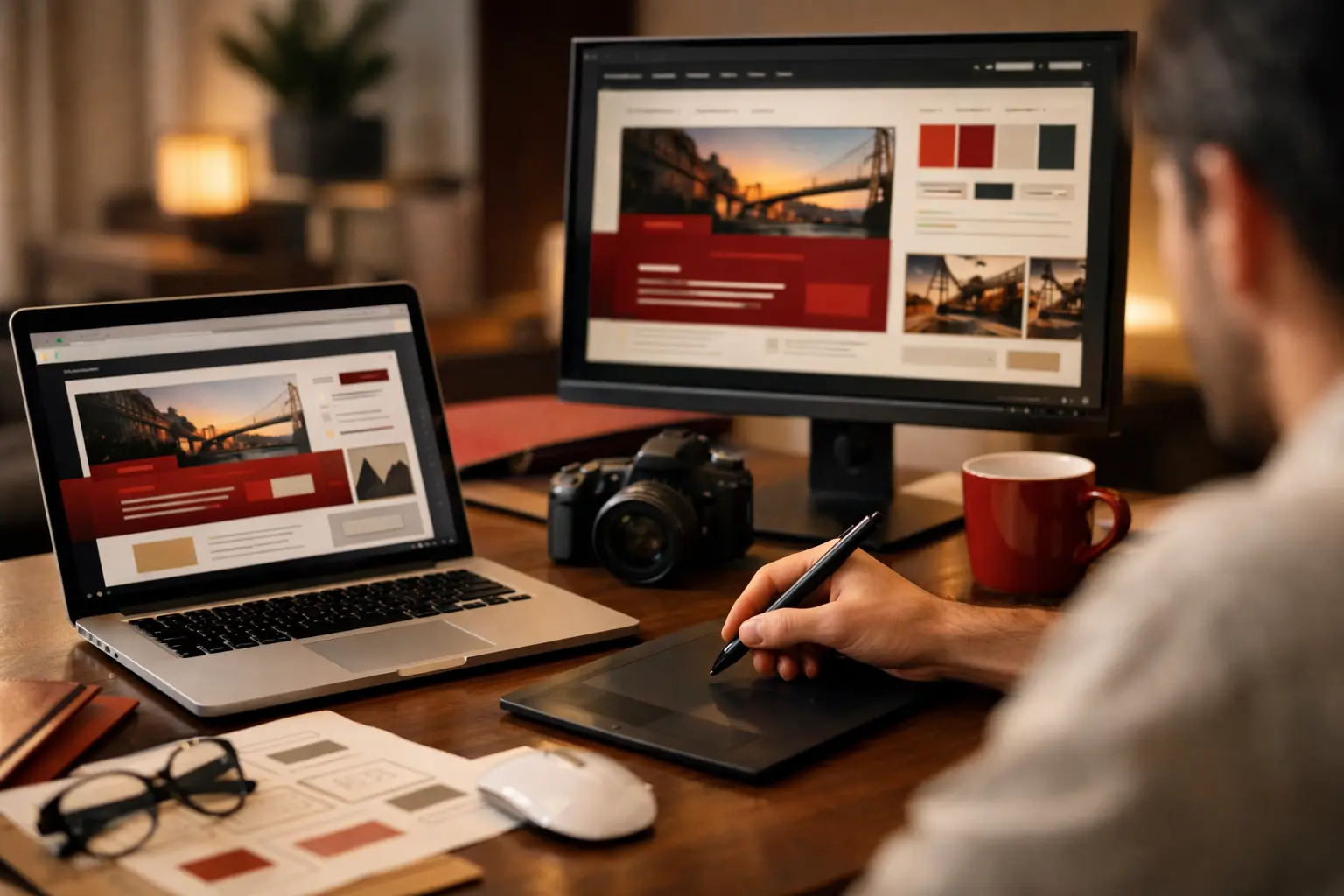
A business website has a job to do, whether that is generating quote requests or helping buyers self-qualify. Good Ipswich web design starts from that job rather than from a template. Judge a supplier on how the work will actually be done, on clarity ahead of surface aesthetics, and on whether technical quality is treated as part of the build.
- Start fromWhat the site is actually for, not a layout
- TemplatesA practical start on a modest budget, not a growth plan
- Judge suppliers onHow the work will be done, past the sales language
- Clarity beatsSurface aesthetics. Communication comes first
- Technical qualityPart of the design, not a separate issue
- Before a full rebuildTargeted improvements are sometimes enough
A lot of Ipswich businesses do not have a traffic problem. They have a website problem. The site looks dated, loads slowly, says too little or far too much, and makes a potential customer work hard to figure out what the business actually does. That is where good web design Ipswich businesses can rely on starts to matter - not as a cosmetic upgrade, but as a commercial one. Ipswich website designer - see how we can help.
If your website is underperforming, the issue is rarely just the homepage. More often, it is the combination of positioning, structure, speed, mobile usability, and weak calls to action. A better website fixes those things together. Done properly, it helps your business look established, build trust faster, and turn more visits into real enquiries.
What good web design in Ipswich should actually do
A business website has a job to do. For some companies, that means generating quote requests. For others, it means helping buyers compare services, understand capability, or feel confident enough to pick up the phone. Either way, the goal is not to impress other designers. It is to make the next step obvious.
That sounds simple, but plenty of websites miss it. They lead with vague slogans, bury key service information, or rely on generic templates that were never built around how the business sells. The result is a site that looks passable at first glance but underdelivers where it counts.
Strong web design starts with structure. Visitors need to know quickly who you are, what you do, who you do it for, and why they should trust you. After that, the site needs to support the decision-making process. That might include service pages with substance, clear contact pathways, proof of experience, or a more thoughtful content hierarchy.
For established SMEs, this is usually where the gap appears. The business has grown, but the website has not kept up. Services have expanded, the team has matured, and the brand has become more capable, yet the site still feels like a small starter business from five years ago.
Why template websites often fall short
Templates are not automatically bad. For a new business with a very modest budget, they can be a practical starting point. But they become a problem when they are stretched beyond what they were built for.
Many Ipswich businesses outgrow templates long before they replace them. The website starts with a generic layout, then gets patched with extra pages, inconsistent messaging, oversized images, plugin clutter, and workarounds for functions it was never designed to handle. Over time, it becomes harder to update, slower to load, and less convincing to the people you want to reach.
This is where custom work earns its keep. Not because every business needs something flashy, but because a site built around your actual services, content, and customer journey tends to perform better. It is easier to manage, easier to scale, and far more likely to reflect the quality of the business behind it.
There is a trade-off, of course. Custom web design costs more than dropping your logo into a prebuilt theme. But that higher upfront cost often saves money later by avoiding rebuilds, technical debt, and the usual cycle of fixing a cheap site in pieces.
Web design Ipswich businesses should look for before signing off
If you are comparing suppliers, it helps to ignore the sales language for a moment and focus on how the work will actually be done. Plenty of providers can show polished mockups. Fewer can explain, in plain English, how the site will support conversions, search visibility, content management, and future growth.
A capable web designer should be able to talk through page structure, mobile behaviour, speed, technical SEO foundations, and how the backend will work day to day. If your business has more complexity, they should also be comfortable discussing integrations, reporting requirements, form workflows, or custom functionality without turning it into agency theatre.
That matters because a website is not a poster. It is part brand asset, part sales tool, and part operational system. If the build quality is poor, those problems show up later in the form of broken enquiries, messy content editing, plugin conflicts, or a site that no one internally wants to touch.
It is also worth asking who is actually doing the work. For many businesses, one of the biggest frustrations is being sold by a senior person, then handed off to layers of account managers and junior production staff. Direct access to the person designing and building the site tends to mean clearer communication, faster decisions, and less room for misunderstandings.
Design quality matters, but clarity matters more
A common mistake in web projects is overvaluing surface aesthetics and undervaluing communication. Yes, your site should look current, professional, and aligned with your brand. But visual polish on its own does not carry the job.
Customers are usually asking basic questions when they land on your website. Can this business solve my problem? Do they look credible? Have they done this before? What happens next? If the design gets in the way of those answers, it is not working hard enough.
That is why the best business websites are often the clearest ones. They use layout, typography, imagery, and content to reduce friction. They guide people through information in the right order. They avoid bloated copy, generic stock messaging, and over-designed interfaces that slow everything down.
In practical terms, that means clear service pages, stronger calls to action, better use of proof points, and content written for real buyers rather than internal assumptions. It also means making sure the site works properly on mobile, because that is often where the first impression happens.
The technical side is not optional
Good design and technical quality should not be treated as separate issues. A site that looks sharp but performs poorly is still a weak asset.
Speed is an obvious example. Slow load times frustrate users, reduce conversions, and can undermine search visibility. The same goes for poor page structure, weak metadata, broken internal logic, and inaccessible layouts. These are not edge-case concerns. They are baseline requirements for a business website that is meant to do real work.
For WordPress sites, technical quality also includes sensible theme and plugin choices, clean builds, manageable content editing, and a backend that does not become a maintenance headache. If your website includes lead routing, booking steps, CRM connections, reporting, or API-based workflows, those pieces need to be thought through from the start rather than bolted on later.
This is one reason many growing businesses prefer a studio that can handle both design and deeper implementation. When branding, web design, technical setup, and supporting collateral are handled together, the result is usually more cohesive and more accountable. There is less finger-pointing, fewer gaps, and a better chance the finished work actually reflects how the business operates.
Local understanding helps, but process matters more
There is value in working with a provider who understands the Ipswich market, especially if your customers are local and your positioning depends on local trust. They are more likely to understand how buyers compare trades, professional services, health providers, industrial firms, and other service businesses in the region.
Still, location alone is not enough. A nearby supplier with a weak process is still a weak supplier. What matters more is whether they can understand your business, define scope properly, communicate clearly, and execute without the usual runaround.
That is especially true for businesses that have outgrown piecemeal marketing. If your website, branding, brochures, signage, and internal documents all feel disconnected, the issue is not just design style. It is a lack of system thinking. Bringing those pieces together creates a more credible customer experience and a more efficient business internally.
Studios like Lovely Pixel are often brought in at exactly that point - when a business needs a website that presents it properly, works technically, and aligns with the broader brand rather than sitting off to the side as a separate project.
When it is time for a redesign
Not every website needs a full rebuild immediately. Sometimes targeted improvements are enough, especially if the technical base is sound. But there are clear signs that a redesign is the better call.
If your site no longer reflects your services, struggles on mobile, loads slowly, is hard to update, or consistently fails to generate quality enquiries, patching around the edges usually just delays the real fix. The same applies if your branding has matured but your website still feels inconsistent or undercooked.
A redesign is also worth considering when your operations have changed. Maybe you now need better lead handling, clearer service segmentation, improved reporting, or integrations with internal systems. At that point, the website needs to support the business you are running now, not the one you started with.
The right web design project is not about making things look newer for the sake of it. It is about building something clearer, faster, and more useful to the people visiting your site and the team managing it behind the scenes.
If you are reviewing web design in Ipswich, the useful question is not whether a provider can make your website look better. Most can. The better question is whether they can make it work harder, with plain-English advice, solid execution, and no agency runaround. That is usually where the real value starts.
Looking for Ipswich web design?
Lovely Pixel is an Ipswich studio working with Springfield, Ripley, Goodna and Western Corridor businesses on WordPress builds, SEO Ipswich and brand collateral - all under one roof.