
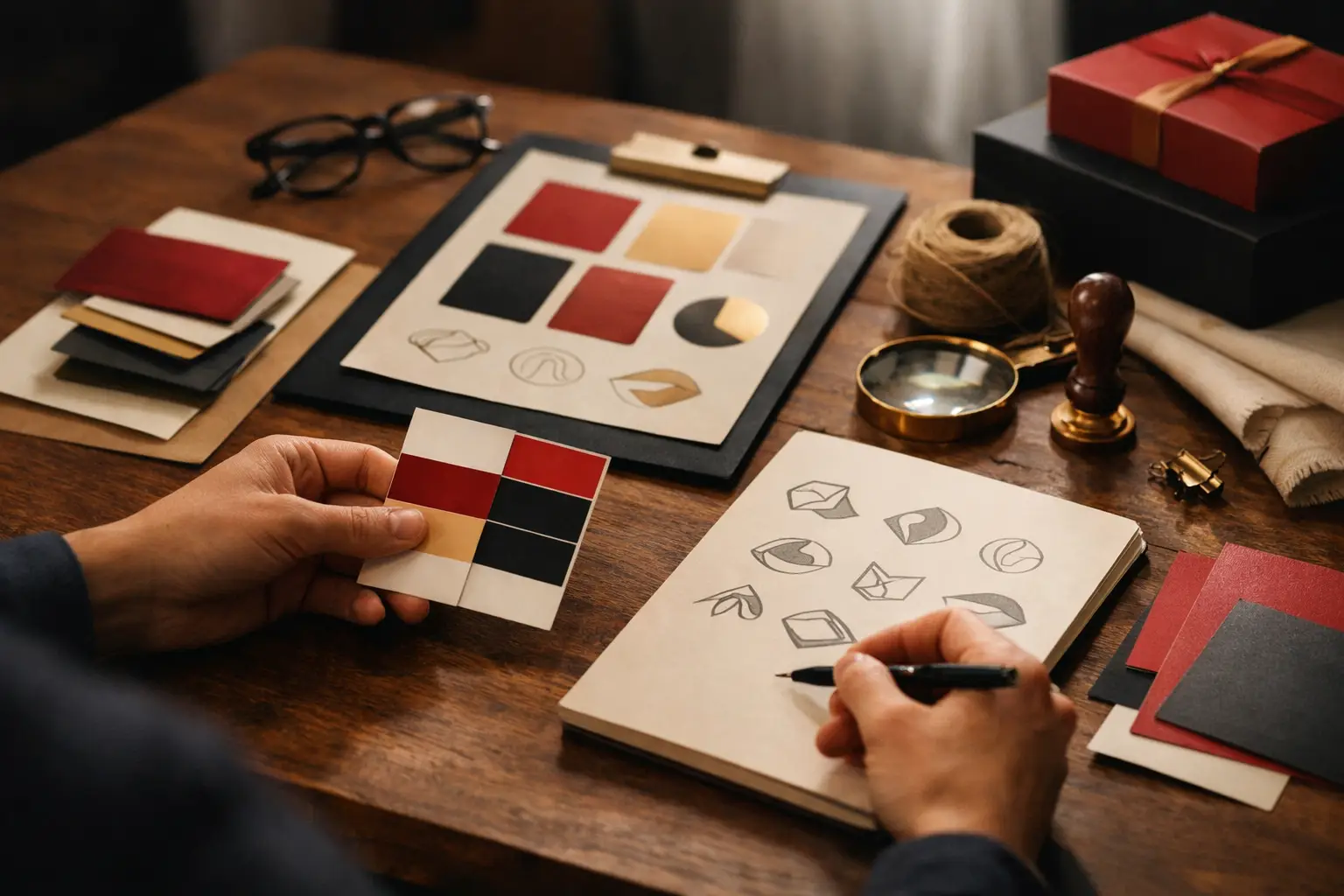
Brand identity is not just a logo. It is the visual system that makes a business recognisable and easier to buy from. Most small businesses end up with a patchy brand by accident, in stages, rather than by decision. Spend on the core assets and resist the parts a small business does not need.
- It isA visual system, not a logo on its own
- How it goes wrongIn stages, by accident, rather than by decision
- The goalEasier to recognise and easier to buy from, not trendy
- Where to spendThe core assets. Not naming workshops and large strategy decks
- Connected toWebsite performance. They should not be handled separately
A lot of small businesses don’t have a branding problem. They have a consistency problem. brand-identity - see how we can help.
The logo might be decent. The website might be passable. The brochure might have been done by one supplier, the signage by another, and the social graphics by whoever had time that week. On their own, each piece can look fine. Together, they make the business feel less established than it really is. That is where brand identity design for small business starts to matter - not as a cosmetic exercise, but as a practical business tool.
If your business is growing, pitching for better work, hiring staff, or trying to lift enquiry quality, your brand identity affects more than appearance. It shapes whether people trust you quickly, whether your marketing looks coherent, and whether your team can produce material without reinventing the wheel every time.
What brand identity design for small business actually means
Brand identity is not just a logo. It is the visual system that helps people recognise your business and understand what kind of operator you are.
That usually includes your logo suite, colours, typography, image direction, graphic elements, layout rules, and the way those pieces are applied across your website, stationery, signage, proposals, brochures, and digital marketing. In some cases, it also includes tone of voice guidance, but the visual side is usually where most small businesses need the most help first.
Good brand identity design for small business makes your business look consistent and credible in the places that matter. It should work on a website header, on a printed capability statement, on a vehicle decal, and in a social post without falling apart. If it only works in one setting, it has not been done properly.
Why small businesses often get this wrong
Most businesses do not deliberately set out to build a patchy brand. It usually happens in stages.
A business starts with a quick logo. Then comes a templated website. Later, someone designs a flyer. A new staff member creates a proposal document. Another supplier produces signage. Over time, fonts drift, colours change, image styles clash, and the business starts presenting itself differently in every channel.
This creates friction. Not always obvious friction, but enough to affect perception. A prospect may not say, “Your visual identity is inconsistent,” but they will notice when a business feels disjointed or underdone. For service businesses especially, where trust is doing a lot of heavy lifting, that impression matters.
There is also an internal cost. Without a clear identity system, every new piece of marketing takes longer to produce. Decisions that should take minutes take days. Team members guess. Suppliers interpret. Output becomes inconsistent because the business has not given anyone a proper framework.
What a strong small business brand identity should do
A useful identity system is not about making a business look trendy. It should make the business easier to understand and easier to trust.
First, it should reflect your market position. A local trade business, a professional services firm, and a premium product brand should not all look the same. The right identity depends on your pricing, audience, sales process, and the level of work you want to attract. Clean and simple is often better than over-designed, but simple still needs direction.
Second, it should improve consistency across touchpoints. Your website, quote documents, signage, brochures, presentation decks, and email signature should feel like they belong to the same business. That sounds basic, but it is one of the clearest markers of professionalism.
Third, it should be usable. This is where many identity projects fall short. A business gets a logo and a few colours, but no practical system. Then six months later, the team is back to guessing font sizes, choosing random stock imagery, or stretching logos into shapes they were never meant to be.
A good identity gives you enough structure to move quickly without making everything look identical.
Where to spend and where not to overspend
Small businesses do need to be sensible here. Not every business needs a large strategy workshop, naming process, and 120-page brand manual.
What you do need depends on the stage of the business and how many touchpoints you are managing.
If you are early stage and validating your offer, a focused identity with a solid logo suite, type system, colour palette, and practical usage guidelines may be enough. If you are established and your website, print collateral, sales documents, signage, and digital campaigns all need to align, you need a more developed system.
The mistake is either going too light or too heavy. Too light, and you are paying for design that does not hold up in real use. Too heavy, and you are funding brand theatre you may not need yet.
The sensible middle ground is an identity built around actual business use. That means considering where your brand appears day to day and designing for those environments from the start.
The pieces that matter most
A strong identity for a small business usually starts with a few core assets, but the detail matters.
Your logo suite should include versions for horizontal, stacked, simplified, and small-format use where needed. One logo file dumped in a folder is not a brand system.
Typography should be chosen for both style and practicality. If your brand fonts look great in a header but are awkward in proposals, presentations, or web use, you will end up with substitutions and inconsistency.
Colour needs more thought than “pick a blue and a green”. Your palette should account for accessibility, print reproduction, screen use, contrast, and flexibility across light and dark applications.
Image direction is often overlooked, yet it makes a huge difference. If your business uses photography, illustrations, icons, or product images, there should be a clear visual direction. Otherwise, your website may feel polished while your social posts and brochures look like they came from a different company.
Then there are the applied assets. This is where the identity becomes useful. Think website UI direction, proposal templates, brochure layouts, business cards, signage concepts, presentation slides, and social graphic styles. For many SMEs, these applications are where the value really shows up because they save time and lift quality across the board.
Brand identity and website performance are closely linked
This is the part many suppliers separate when they should not.
A business can have a good-looking brand and still end up with a weak website if the identity has not been built with digital use in mind. On the other hand, a website can be technically sound but still underperform if the branding feels generic or inconsistent.
Your brand identity influences how your website communicates hierarchy, trust, tone, and professionalism. It affects how clearly calls to action stand out, whether pages feel considered, and whether users believe they are dealing with an established operator.
For small businesses, that means branding should not live in a vacuum. It should connect with web design, content structure, speed, responsiveness, and conversion thinking. Done properly, these are not separate conversations.
How to tell if your current brand identity is holding you back
Sometimes the signs are obvious. Your website looks dated, your marketing collateral is inconsistent, or your logo does not reproduce properly in print. Other times, the issue is subtler.
If different suppliers keep interpreting your brand differently, you probably do not have a real brand system. If new documents always take too long to design, the system is not practical enough. If your business has moved upmarket but still looks budget, your identity is out of step with your positioning.
There is also the credibility test. When someone sees your website, proposal, signage, and brochure in the same week, does it all feel aligned? Or does it feel like a collection of unrelated materials? That answer usually tells you more than any branding jargon will.
What to expect from a proper identity project
A worthwhile brand identity project should give you clarity, not confusion.
That means a clear design direction, rationale behind key decisions, and deliverables built for actual use. You should come out of the process with files you can use properly, guidelines that make sense, and applications that reflect the way your business really operates.
It also helps when the same studio understands both digital and print production. A brand should not look one way on screen and fall apart when it hits paper, signage, or packaging. For businesses with multiple marketing channels, that joined-up thinking saves time and avoids the usual supplier gaps.
If you are in Brisbane, Ipswich or Logan and dealing with scattered branding across web and print, that practical overlap becomes even more valuable. It is easier to get consistent outcomes when one senior team is looking at the full picture rather than treating each asset as a separate job.
Brand identity design for small business works best when it is grounded in how the business actually sells, communicates and grows. Not what looks clever in a presentation deck. Not what is fashionable this year. Just a clear, professional system that helps your business show up properly wherever customers encounter it.
If your brand currently feels like a patchwork, that is not a minor design issue. It is usually a sign that your business has outgrown improvised decisions and needs a system that can carry the next stage of growth.
Need a brand identity that holds together everywhere?
Identity systems and rollout assets for websites, print, signage, templates and everyday marketing.