
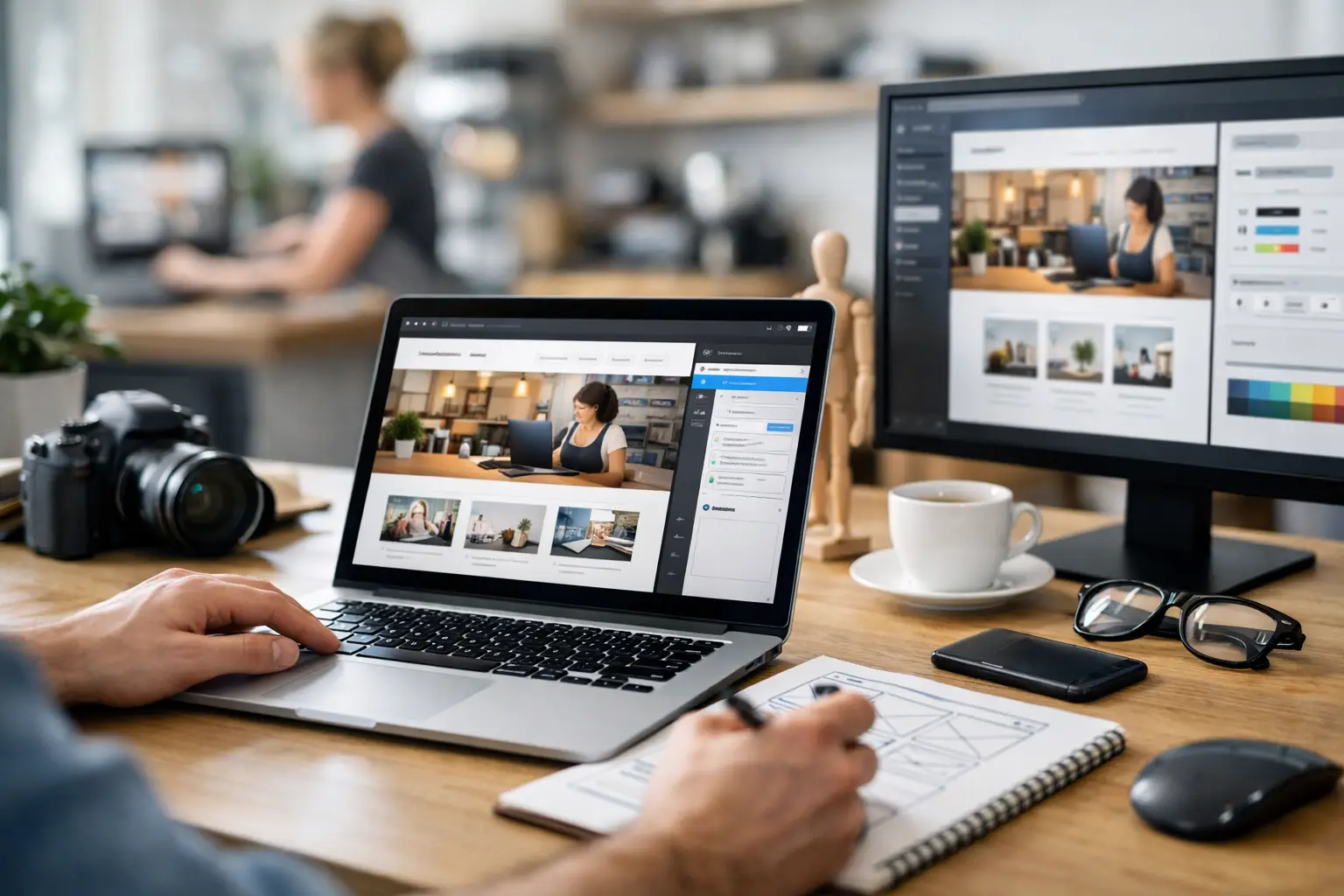
Custom does not have to mean overengineered. Done properly it means the site is designed and built around your business rather than fitted into a theme. It is worth the investment when you rely on regular lead generation and have a defined proposition, and it is usually not worth it for a brand-new business still finding its feet.
- Custom meansBuilt around the business, not fitted to a theme
- Templates stop working whenThe operation outgrows how the site presents it
- A proper build starts withClarity about the business, before any design mockups
- SEO and speedPart of the build, not extras added afterwards
- Worth it whenYou rely on lead generation and have a defined proposition
- Depends most onWho plans and builds it, more than on the platform
A small business website usually starts showing its limits at the worst possible time - when traffic is growing, the team is busier, and the business finally needs the site to do more than just exist. That is usually the point where a custom WordPress website for small business starts making commercial sense. Not because custom is fashionable, but because templates and patchwork fixes often stop being good enough. WordPress development - see how we can help.
For many Australian businesses, the issue is not having no website. It is having a website that looks acceptable at a glance yet underperforms in all the places that matter. It loads slowly, the page builder is bloated, the branding feels inconsistent, enquiries are weak, and basic updates become harder than they should be. On paper, the site is live. In practice, it is getting in the way.
What a custom WordPress website for small business actually means
Custom does not have to mean overengineered. Done properly, it means the website is designed and built around your business, your customers and your workflow rather than around the limits of an off-the-shelf theme.
That can include custom page layouts, a cleaner content structure, better performance, stronger technical SEO foundations, tailored enquiry forms, integration with third-party systems, and a back-end that is easier for your team to manage. It can also mean the design reflects the actual quality of your business instead of looking like fifty other sites in your category.
This matters more than many owners expect. A website is often the first serious credibility check a prospect makes. If the business presents well in person but the site feels dated, generic or clunky, that gap creates doubt. People may not say it out loud, but they notice.
Why templates stop working
Template websites have their place. For a brand-new business with a tight budget, a simple theme can be a reasonable starting point. The problem starts when that temporary solution quietly becomes permanent.
Most template-based builds are made to suit everyone, which means they are not especially well suited to anyone. You inherit layout decisions, code bloat and plugin dependencies that were never chosen for your business. As new needs come up, booking tools, CRM connections, location pages, staff profiles, gated resources, reporting, the site becomes a stack of compromises.
That is where costs start hiding. The business spends money patching rather than improving. Changes take longer. Performance suffers. SEO work gets harder because the technical foundation is messy. Design consistency slips because the template was not built around your brand system in the first place.
A custom build is not automatically the right answer for every business, but it often becomes the smarter answer once the website needs to support growth rather than simply tick a box.
The real business case for custom
A custom WordPress website is not just about aesthetics. It affects how efficiently your business communicates, converts and operates.
If your enquiries are valuable, even small conversion improvements matter. A clearer page structure, better calls to action, faster load times and more thoughtful content hierarchy can improve the number of qualified leads coming through. That is not theory. It is basic friction reduction.
Then there is internal efficiency. Many SMEs lose time dealing with website admin that should be simple. Product updates are awkward. Team pages are inconsistent. Landing pages need a developer for minor edits. Reporting sits in separate systems. In some businesses, website work spills into operations, sales and client service more than expected.
This is where a more tailored approach pays off. The site can be structured around what your team actually needs to update, what customers actually need to find, and what your systems actually need to connect to.
What to expect from a custom WordPress build
A proper custom build should start before design mockups. It should begin with clarity around the business itself: what you sell, who you sell to, how people buy, where leads come from, what content matters, and what the website needs to do over the next few years.
That strategy informs the structure. Pages are planned around user intent, not guesswork. Navigation is simplified. Service content is organised in a way that supports both decision-making and search visibility. If the business has multiple service lines, locations or audiences, that complexity is handled deliberately rather than bolted on later.
Design then has a job to do. Yes, it should look polished and on-brand. But it also needs to communicate trust quickly, guide people toward action and support readability across desktop and mobile. Good design is not decoration. It is a commercial tool.
The development side matters just as much. A custom WordPress website for small business should be built with performance, maintainability and clean code in mind. That means avoiding unnecessary bloat, choosing plugins carefully, setting up sensible content fields, and making sure the back-end is usable for the people who will actually manage it.
SEO, speed and technical quality are not extras
A lot of businesses treat SEO as something separate from the website build. That is often a mistake. If the site architecture is poor, the code is bloated, the metadata setup is inconsistent, and the page speed is weak, later SEO work becomes more expensive and less effective.
A custom site gives you a better chance to get the fundamentals right from the start. That includes heading structure, crawlable content, logical internal page relationships, image handling, mobile responsiveness, schema where relevant, and a setup that does not fight every future improvement.
Speed matters for the same reason. Slow websites frustrate users, weaken conversion and create avoidable performance issues. Many cheap builds become slow because they rely on heavy themes, too many plugins and layers of workarounds. Custom development does not guarantee a fast site, but it does remove a lot of the usual baggage.
Branding matters more than most websites show
One of the clearest signs a business has outgrown its website is the disconnect between the quality of the operation and the quality of the presentation. The business may be established, capable and well regarded, yet the website still looks like a starter package.
A custom site helps bring the brand into line with reality. That includes typography, colour, imagery, tone of voice and overall consistency across web and print. For businesses investing in brochures, signage, proposals, catalogues or other collateral, alignment matters. Prospects notice when everything feels joined up. They also notice when it does not.
This is one reason many growing businesses prefer working with a studio that understands both branding and implementation. The gap between a nice-looking concept and a website built properly is often wider than expected.
When custom is worth it, and when it is not
There are cases where custom is clearly worth the investment. If your business relies on regular lead generation, has a defined brand, offers higher-value services, needs system integrations, has outgrown a template, or wants stronger control over performance and content, custom is usually justified.
If your business is very early-stage, has a single simple offer, and only needs a modest online presence for now, a leaner approach may be more sensible. There is no value in paying for complexity you do not need.
The honest answer is that it depends on the role the website plays in the business. If it is a serious sales and credibility asset, build it accordingly. If it is a temporary placeholder, keep it proportionate.
Choosing the right partner matters as much as the platform
WordPress is flexible, but the result depends heavily on who plans and builds the site. Plenty of businesses end up frustrated not because WordPress is the wrong platform, but because the project was rushed, overcomplicated or handed through too many layers.
The better approach is direct, senior-led and plain English. You want clear scope, sensible recommendations, and someone willing to explain trade-offs honestly. Not every business needs custom integrations or advanced functionality. Some do. The point is to get advice based on actual business requirements, not on selling the biggest possible project.
That is the difference between a site that is merely launched and one that is done properly.
For small and growing businesses, a website should not be a source of friction, embarrassment or constant rework. It should support the brand, help generate enquiries, and make life easier for the team behind it. If your current site is no longer keeping up, that is usually not a sign to keep patching it. It is a sign to build something that fits the business you have now, and the one you are growing into.
The practical side: themes, plugins, hosting and upkeep
"Custom" does not have to mean complicated or expensive to run. A few practical choices are what separate a custom build that stays fast and easy to manage from one that quietly rots:
- A lean custom theme over a heavy page builder. Page builders are quick to start with but stack up code that slows the site and makes it fragile. A purpose-built theme loads faster, is easier to maintain and gives you editor-friendly blocks without the bloat.
- Fewer, well-chosen plugins. Every plugin is code someone else maintains. We use a small, deliberate set for SEO, forms, security and performance rather than a dozen overlapping ones.
- Business-grade Australian hosting. Cheap shared hosting is fine until traffic or a plugin conflict takes the site down at the worst moment. Properly specified hosting keeps it fast for local visitors and gives you real support.
- Content you can edit yourself. A custom build should hand a non-technical owner clean, labelled blocks - update a price, swap a photo, add a service - without touching code or breaking the layout.
- Maintenance that is not optional. Updates, backups and security are the difference between a site that lasts years and one that gets hacked or breaks after an update.
A lot of these builds are for small businesses across Ipswich and the Western Corridor - see Ipswich web design for local examples, or WordPress speed optimisation if an existing site is the thing holding you back.
Need a WordPress site that won't fall over?
Custom WordPress builds with editor-friendly content, WooCommerce when needed, and SEO-ready structure from day one.