
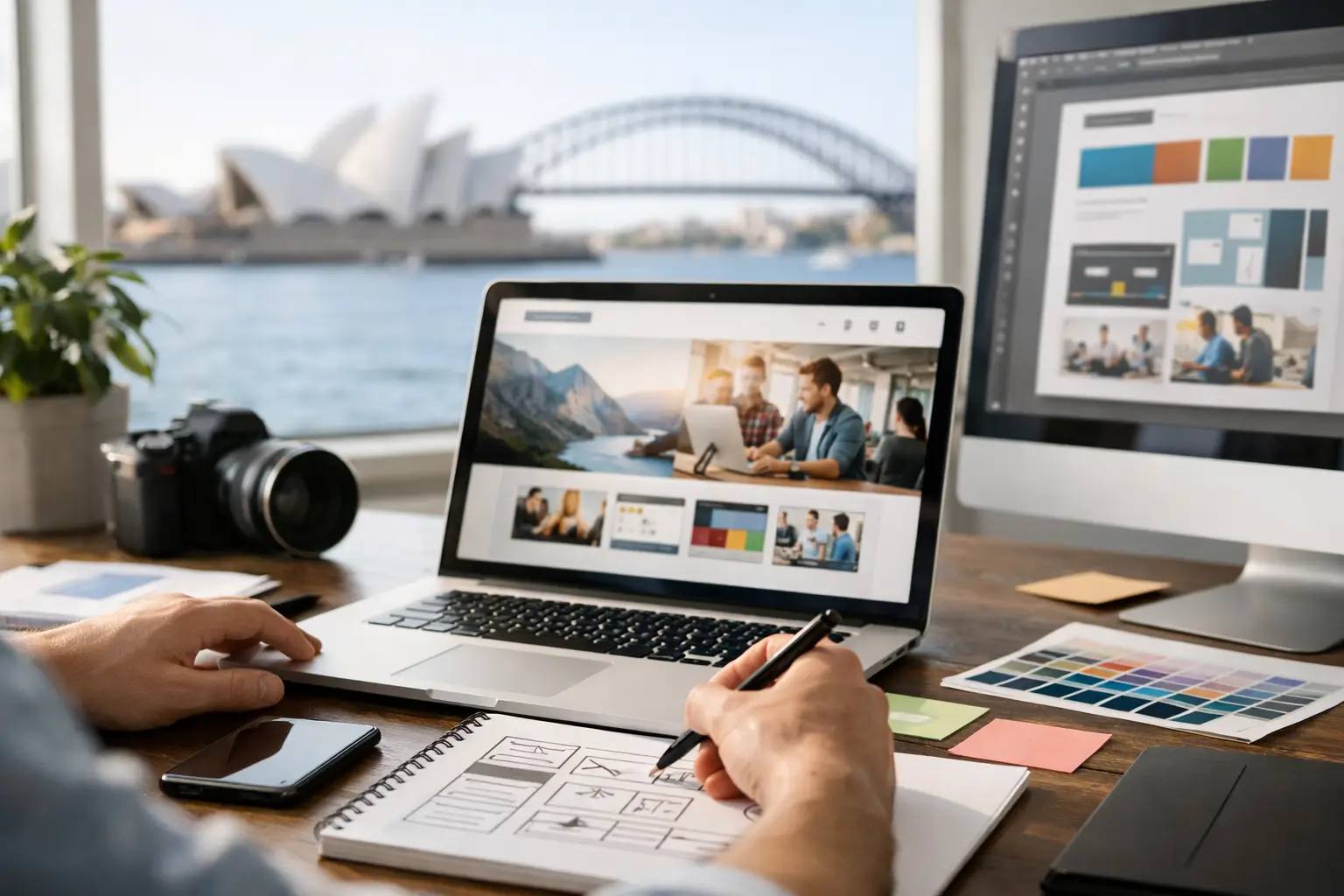
A website usually asks for a redesign long before anyone says it out loud. Enquiries slow down. The mobile experience feels clunky. Staff avoid updating pages because the backend is a mess. If you're considering a wordpress website redesign australia businesses actually benefit from, the real question is not whether the site looks dated. It is whether the current site is helping or quietly getting in the way.
For established SMEs, a redesign is rarely just a visual exercise. It is often tied to a rebrand, a shift in services, new internal workflows, SEO problems, slow load times, or years of layered fixes that have made the site harder to manage. Done properly, a redesign gives you a cleaner brand presentation, better technical foundations, and a site that is easier to run day to day. Done badly, it creates extra cost, ranking losses and another rebuild in two years.
What a WordPress website redesign in Australia should actually solve
A good redesign starts with business problems, not moodboards. If the brief is just make it look more modern, there is a fair chance important issues stay untouched. Design matters, but only when it supports clearer messaging, easier navigation, stronger conversion paths and a better user experience.
For many Australian businesses, the common problems are predictable. The site may be running on an old theme with too many plugins. Page layouts might be inconsistent because multiple people have edited them over time. The brand may have evolved offline, while the website still reflects an earlier version of the business. In some cases, the website was built to launch quickly and never properly revisited once the business grew.
A redesign should fix those underlying issues. That can include improving page speed, simplifying the content structure, tightening calls to action, rebuilding templates so they are consistent, and making sure the backend is manageable by your team. If your business relies on forms, reporting, CRM sync, booking systems or custom data flows, the redesign also needs to account for those operational requirements from the start.
Redesign or rebuild - they are not always the same thing
This is where plain English matters. Some projects are genuine redesigns, where the existing content structure, platform and SEO equity are worth keeping while the visual system and page templates are upgraded. Others are really rebuilds, even if everyone keeps calling them a redesign.
If your current WordPress site is technically sound, has clean URLs, and already ranks for useful search terms, keeping the core structure may be sensible. If it is bloated, fragile, hard to edit and missing key functionality, trying to preserve too much can be false economy. You can spend a surprising amount of money trying to rescue a poor build.
The right approach depends on what is under the bonnet. That is why any serious redesign process should begin with an audit of the current site, including speed, mobile usability, plugin quality, indexing, content performance and backend usability. Without that, decisions are based on assumptions.
The mistakes that make redesigns expensive
The most expensive redesign mistakes usually happen before design starts. One is skipping discovery and moving straight into visual concepts. Another is treating every page equally, when in reality some pages carry the commercial weight and others barely matter.
There is also a common tendency to remove content too aggressively in the name of simplicity. Cleaner does not always mean better. If key service pages, location pages or resource content are bringing in qualified traffic, deleting them can hurt visibility and enquiries. A better move is often to improve the structure, rewrite weak sections and consolidate duplication.
Then there is the agency-layer problem. Businesses are told they are getting strategy, design and development, but communication is filtered through account managers and the person doing the work is several steps removed from the brief. That creates delay, confusion and soft accountability. For a redesign project with technical and commercial consequences, direct access to the person building it usually leads to better decisions and less rework.
What to review before you redesign
Before any layouts are designed, it helps to get honest about what is working and what is not. That means looking at enquiry quality, traffic sources, device behaviour, high-exit pages, top-performing service pages and how easy the site is for staff to update.
Brand alignment matters as well. If your logo, colours, typography and sales material have changed, the website needs to reflect that shift consistently. This is especially important for businesses using brochures, proposals, signage and printed collateral alongside the site. A redesign should not create a disconnect between your online and offline presentation.
Content is another big one. Most websites do not need more words. They need better structure, clearer hierarchy and stronger messaging. If a visitor cannot work out what you do, who it is for and what to do next within a few seconds, the issue is usually positioning and page architecture, not just visual style.
How a WordPress website redesign Australia project should be approached
For Australian SMEs, the most practical process is usually staged and grounded in scope. Start with audit and discovery. Clarify what must be retained, what should be improved and what needs to be rebuilt entirely. From there, move into sitemap planning, content direction and page priorities before visual design goes too far.
This order matters because it prevents attractive but impractical design decisions. It also keeps the project tied to outcomes such as better conversion, improved speed, stronger SEO foundations and easier content management.
During design and development, there should be a clear focus on responsive behaviour, template consistency, call-to-action placement, accessibility basics and technical cleanliness. On WordPress, that means not overloading the site with unnecessary plugins or relying on a brittle setup that only the original developer understands.
Launch planning deserves more attention than it usually gets. Redirects, metadata, analytics, form testing, indexing settings and page speed checks should all be handled before the site goes live. If the redesign includes domain changes, restructured URLs or major content consolidation, migration planning becomes even more important.
Why WordPress still makes sense for many Australian businesses
WordPress remains a strong fit for many SMEs because it offers flexibility without locking the business into a closed system. It can support custom design, content growth, SEO control and integration with other tools when needed. That said, the quality of the build matters more than the platform name.
A well-built WordPress site is fast, manageable and scalable. A badly built one is the opposite. That is why redesign decisions should focus less on trend-driven platform switching and more on whether the site is being rebuilt with clean structure, sensible functionality and long-term maintainability in mind.
For businesses with more operational complexity, WordPress can also sit alongside reporting workflows, APIs, forms, internal dashboards or lead handling processes. That is often where a senior specialist is more useful than a design-only supplier. The website is not always the whole system. Sometimes it is the front end of a broader business workflow.
Budget, timing and expectations
Redesign budgets vary because the work varies. A brochure-style site refresh is very different from a full custom rebuild with brand refinement, SEO restructuring, integrations and new collateral. The fastest way to get a misleading quote is to ask for a redesign price without defining what is actually being redesigned.
Timing depends on approvals, content readiness and project complexity as much as design or development hours. If your team is still refining services, updating brand assets or rewriting core messaging, that will affect the timeline. The right supplier will tell you that early rather than pretend everything fits a neat package.
This is also where honesty matters. Not every business needs a dramatic redesign. Sometimes the right move is a targeted uplift to key pages, performance improvements and cleaner templates. Other times, patching the old build just prolongs the problem. It depends on the current site, your growth stage and how much technical debt you are carrying.
Lovely Pixel works with businesses in exactly this position - where the site needs to look sharper, perform better and be built properly without agency runaround.
A redesign is worth doing when it gives the business more than a prettier homepage. It should make your brand clearer, your marketing easier and your website less of a liability to maintain. If you approach it with that standard in mind, you are far more likely to end up with something that still makes sense two years from now.
Need help with your website or branding?
We design WordPress sites, brand identities and print collateral for Australian businesses.